 Back to news
EUFAWREADY Partner CABI Co-hosts ISBCA7 in Nairobi, with a Dedicated Session on Fall Armyworm
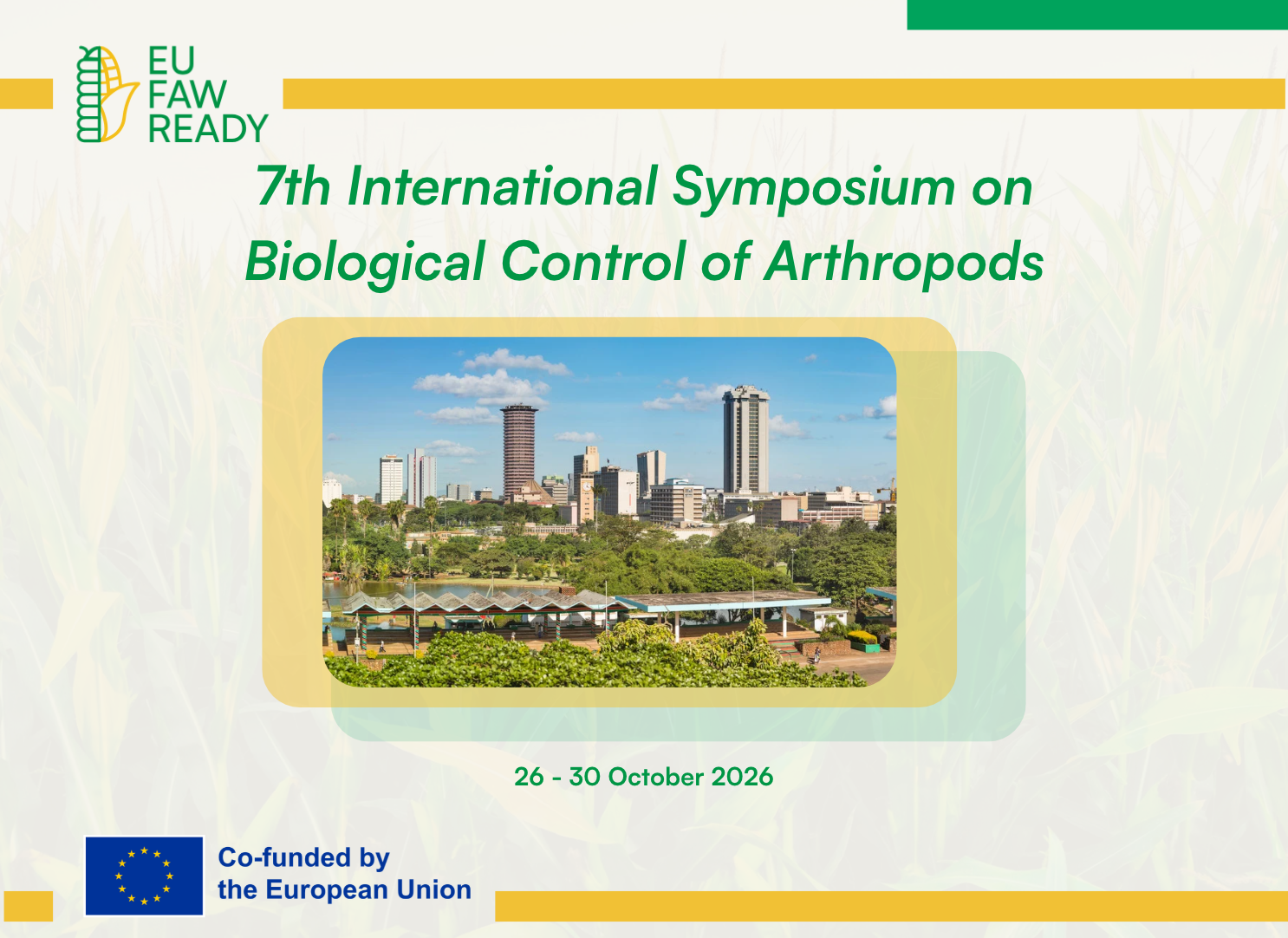
The 7th International Symposium on Biological Control of Arthropods (ISBCA7) is taking place in Nairobi, Kenya, from 26 to 30 October 2026. It is co-hosted by EUFAWREADY project partner CABI and the Kenya Agricultural and Livestock Research Organization (KALRO). The venue is the KALRO Conference Centre at the organisation’s headquarters on Kaptagat Road, Loresho.
This edition is a milestone for the symposium series. Earlier meetings were held in the Americas, Europe, Australasia and Asia, and ISBCA7 is the first to take place in continental Africa.
A meeting point for the biological control community
ISBCA brings together researchers, practitioners and other stakeholders working on biological control. They meet to share knowledge and experience and to discuss new developments in the field. The symposium covers the main approaches to managing arthropod pests with natural enemies: conservation, augmentation and the importation of natural enemy species. It also addresses broader questions, such as how biological control is adopted, the challenges of putting it into practice, and its socio-economic impacts.
This year’s programme includes 13 scientific sessions and panels proposed by colleagues from around the world. The organisers have placed particular emphasis on involving postgraduate students and postdoctoral researchers, with the aim of building a diverse, inclusive and collaborative international community.
Fall armyworm in the spotlight
On Thursday, 29 October, Scientific Session 10 turns to “Biological control of fall armyworm (FAW) in temperate and subtropical climates.” The session is convened by Marc Kenis (CABI), with Zhang Yibo (Institute for Plant Protection at the Chinese Academy of Agricultural Sciences (CAAS)) as co-convenor.
FAW is mostly known as a tropical pest, but it can also become established in subtropical regions, and its migration capacity brings it into temperate ones too. Because biological control approaches can vary with local climate and cultivation practices, the session will look at examples used or studied in subtropical and temperate regions around the world.
The full programme and session topics are available on the ISBCA7 website.