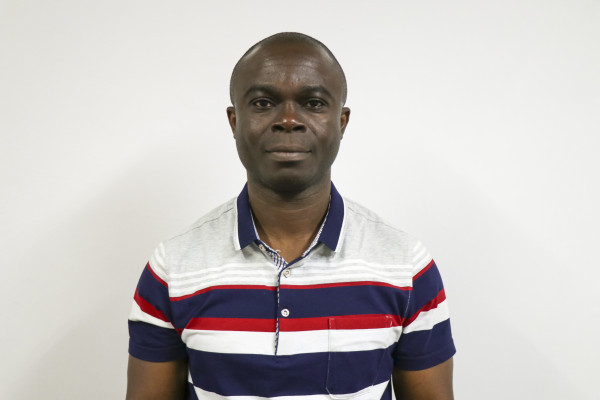
Senior Scientist and Head, Arthropod Pathology Unit at the International Centre of Insect Physiology and Ecology (icipe)
Dr Komivi Senyo Akutse is an Agricultural Entomologist/Arthropod Pathologist and IPM Specialist. He is a Senior Scientist and Head, Arthropod Pathology Unit at the International Centre of Insect Physiology and Ecology (icipe), where he tremendously contributed to the development and registration of several biopesticides against major agricultural and livestock pests in Africa. He joined icipe in 2017 as a Biopesticide Development Scientist. Before joining icipe, Dr Akutse was a Postdoctoral Research Fellow at the Institute of Applied Ecology, Fujian Agriculture and Forestry University, China, where he worked on pathogens and endophytes associated with diamondback moth and its host plants under the umbrella of ecological-based pest management strategies in different agroecosystems. Prior to this, between 2013 and 2015, he worked as a Postdoctoral Fellow at icipe, where he carried out research on IPM technology development and application, farming system comparison, and insects for food and feed. He is an expert in biological control, with strong skills in pathogen-insect-plant interactions. He obtained his PhD in Agricultural Entomology at North-West University, South Africa and where he is currently an Extraordinary Professor in the Research Unit for Environmental Sciences and Management. He also holds a MPhil. in Entomology at University of Ghana and a BSc in Agricultural Sciences at INFA-Togo. He has authored and co-authored over 130 peer-reviewed publications, several book chapters, policy documents, and more than 100 conference contributions, with H-index of 36. He has mentored several Postdocs, PhD, MSc, BSc and internship students.
Andrea Ficke
Cereal Plant Pathologist at the Norwegian Institute for Bioeconomy Research
Andrea Ficke is a cereal plant pathologist working on fungal diseases in wheat, barley and oilseed crops at the Norwegian Institute for Bioeconomy Research in Ås, Norway. Her main interests are disease detection, forecasting and managing, crop loss assessment, chemical ecology and fungicide resistance. She is coordinating the Horizon Europe funded project ‘Plant pest prevention through technology-guided monitoring and site-specific control (PurPest) and leads the work package on VOC specifications in the HEU project ‘Portable air analysis device for on-sit pest detection during plant import controls’ (senseApest).
Dr Feng Zhang
Regional Director, East & South-East Asia CAB International (CABI)

Dr Feng Zhang is Regional Director for East and South-East Asia of CABI, an international intergovernmental organisation owned by 48 member countries. He has more than 20 years of experience working in agriculture sector with a research focus on biological control of agricultural insect pests, such as Asian corn borer, western corn rootworm, fall armyworm and brown marmorated stink bug. He has also implemented a dozen of development cooperation projects to promote uptake of biological control in developing countries. He has made significant contributions in establishing the MARA-CABI Joint Laboratory for Bio-safety, and its’ further expansion to become a global network on transboundary pest management and technology sharing through south-south cooperation. He now serves as the Steering Committee member of the Joint Lab as well as an Adjunct Professor at the Institute of Plant Protection, Chinese Academy of Agricultural Sciences. He also serves as Co-Convenor for International Working Group on Ostrinia and other maize pests (IWGO) of International Organization of Biological Control (IOBC), and Associate Editor for Biological Control as well as CABI Agriculture & Bioscience.
Ted C. J. Turlings
Ted Turlings is an emeritus professor of chemical ecology at the University of Neuchâtel, Switzerland, a foreign expert professor at Henan University in China, and has a part-time teaching appointment at Penn State University in the USA. Throughout his career, he has made various contributions to the understanding of plant-insect interactions, particularly the role of volatile organic compounds (VOCs) in plant defense and pest management. His current research aims to have an impact on sustainable agriculture, advancing technologies for detecting and mitigating agricultural threats.